The laws of Category Design: What I wish I knew before starting up 10 years ago, and how I will rethink before starting up today
Two years ago, I was a judge at an EdTech startup pitching event in India when a young founder of one of the companies asked me ‘what would you do differently if you were to start up again?’ Having been a brick and mortar education entrepreneur, my answer was ‘to better leverage technology to build a robust customer acquisition engine’. Looking back at that moment, I realise I may have given the wrong answer.
The one big difference between starting up now and starting up when I did 10 years ago, is the rate of internet penetration and adoption. The number of people using the internet has doubled (4.8 billion representing 61% of the world’s population), and the average time spent per person has shot up from 30 mins to 4 hours per day. The internet has moved the world from scarcity to abundance by enabling consumers to get access to an unlimited selection of products – called the long tail. This has fundamentally changed the way internet businesses think about success compared to the physical era.
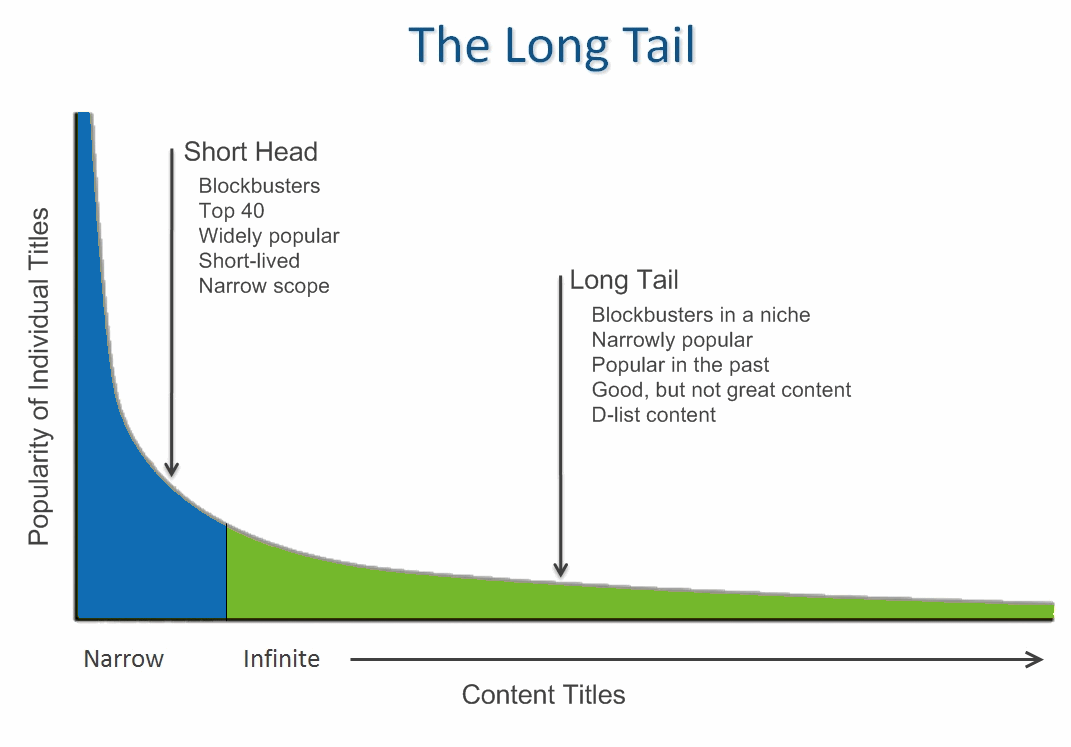
In the book ‘The Long Tail’, author Chris Anderson writes:
“What's really amazing about the Long Tail is the sheer size of it. Take books: The average Barnes & Noble carries 130,000 titles. Yet more than half of Amazon's book sales come from outside its top 130,000 titles. Consider the implication: If the Amazon statistics are any guide, the market for books that are not even sold in the average bookstore is larger than the market for those that are. This is not just a virtue of online booksellers; it is an example of an entirely new economic model for the media and entertainment industries, one that is just beginning to show its power. Unlimited selection is revealing truths about what consumers want and how they want to get it in service after service. As they wander further from the beaten path, they discover their taste is not as mainstream as they thought.”
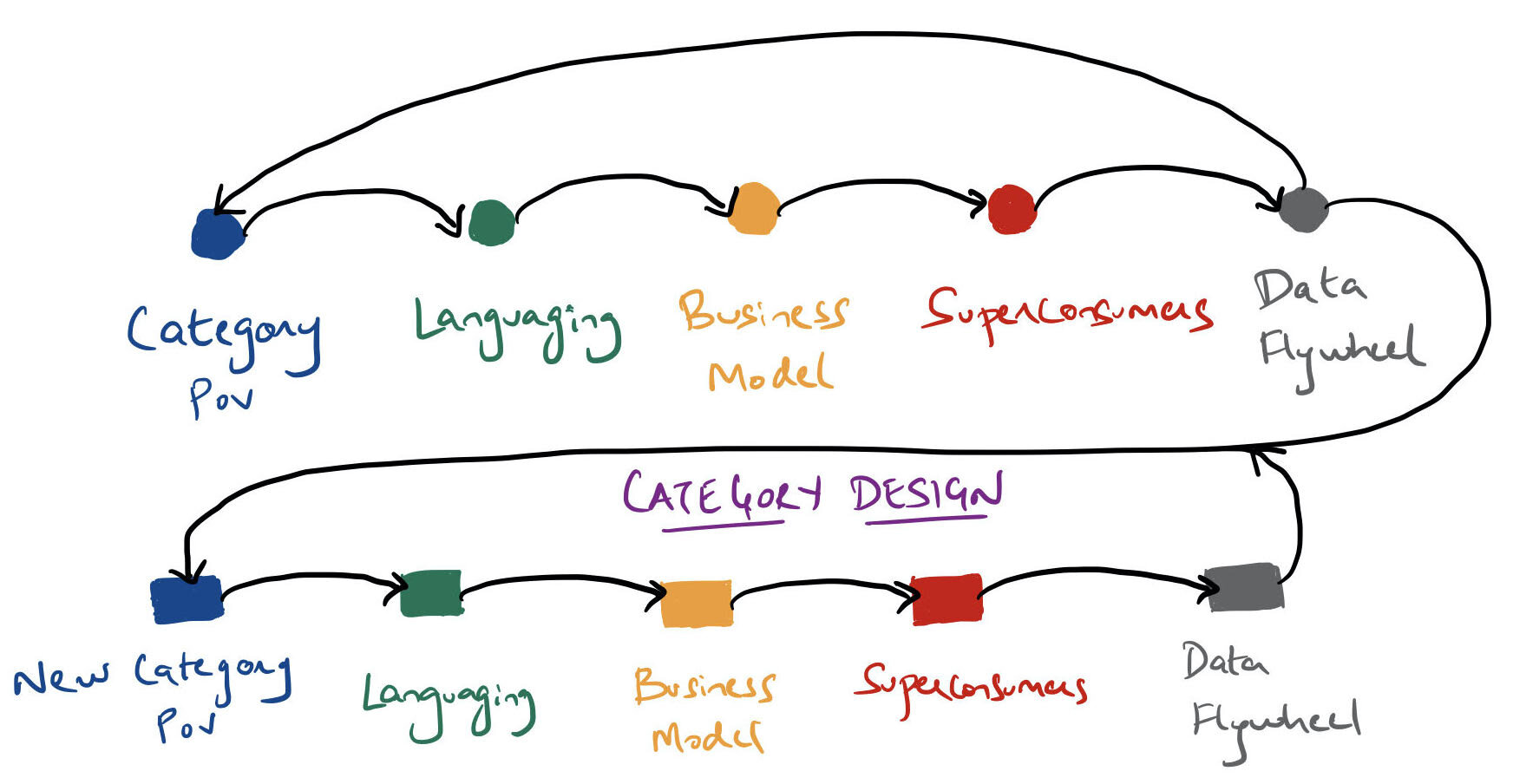
No one has influenced my thinking on how to benefit from the long tail and win the game in the internet economy more than Eddie Yoon, Christopher Lochhead and Nicholas Cole. The core essence of their message is that with consumers having access to so much variety and agency, the online world rewards businesses that are obsessed about creating a new category by owning a specific but universal niche (a specific need that is unfulfilled for a very large number of people, e.g.: Tesla, Spotify, Netflix). Category Design is a business strategy that focuses on creating a new marketing category, which can then be monetized and monopolized before competitors enter the space. This is different from an obsession to make the best product or be the biggest business in an existing market, which is how most businesses succeed in the offline physical world (e.g.: Intel, Xerox, Kodak).
How does one think about owning a specific niche and designing a new category? Here are 5 compelling ideas from Yoon, Lochhead and Cole in the context of starting an education venture 10 years ago vs. starting an education venture today.
1. Point Of View (POV)
“Frame it, Name it, and Claim it.
Your point of view is the hook for the consumer while being your true north. It’s a unique insight that only you have about the problem. It articulates a compelling vision and tells the customer what you stand for, and what difference you make to the world. It communicates the core compromises, trade-offs, and problems inherent to the way the category is today, such that the consumer will be open to a new and different approach.”
The point of view when I started 10 years ago was that the school science curriculum is theoretical and so children need additional hands-on experiential STEM (science, technology, engineering, math) classes to truly appreciate and understand how the world works. I ended up being slotted into the extracurricular ‘hands-on hobby science’ category which was a good to have but not a need to have. This made it harder for me to differentiate myself as well as integrate into school timetables.
If I were to rebuild the school system today, I would frame a very different point of view. The school curriculum hasn’t changed in 100 years while the world of careers is becoming more entrepreneurial and changing every 6 months. With attention spans declining, we need to leverage technology and the internet to systematically alter and personalize the way we educate our children so as to capture their curiosity, fire up their inherent motivation, and hone their abilities to become interdisciplinary problem solvers for the 21st century. My unique insight being that there’s a specific way to blend the power of the internet with hands-on learning to help children develop timeless competencies for career success.
I would create ‘The BlendSchool’ – a new category of blended schools for 21st century learning.
2. Languaging
“Languaging is the strategic use of language to change thinking. It’s a way to powerfully communicate your category point of view by creating distinctions between old and new, same and different. Legendary category designers are languaging masters. A demarcation point in language creates a demarcation point in thinking, creates a demarcation point in action, creates a demarcation point in outcome. When Henry Ford called the first vehicle a “horseless carriage,” he was using language to get the customer to STOP, listen, and immediately understand the FROM-TO: the way the world was to the new and different way he wanted it to be.”
Here’s how I will use languaging to differentiate the 21st century BlendSchool
Which school are you studying in? —> Which blendschool are you logged into?
What class are you teaching? —> What cohort are you coaching?
What subject are you studying? —> What problem are you solving?
What’s your grade 6 curriculum? —> What’s your interdisciplinary competency?
Where’s your schoolbag? —> Where’s your blendtab?
What type of student are you? —> What type of creator are you?
3. Superconsumers
“A “Super” is an evangelist who knows your category better than anyone else—oftentimes, even better than you do. In short, they’re the consumers pushing the category forward (whether they realize it or not). They are receptive to the new. They are looking for ‘different.’ Although Supers are few in number—usually about 10% of consumers for a particular product or category, they can drive between 30% and 70% of sales.
Supers are the gurus who can help you innovate, and are the ones who will spread the word about how amazing your products are to other consumers (and more specifically, other Supers). They love to talk, share, post, and educate others on the category as well as on radical transformational outcomes: stories of how their lives have dramatically changed after engaging with your company. And no matter what new marketing tactic is the vanguard of the moment, nothing will ever beat word of mouth. (And your job is to put the right words in the right mouths!)
In my first venture, I did not think much about who our customers were (parents or children) or how they were consuming in other related categories like sports, art or drama in order to understand their personas. The focus was to just to reach out to as many parents as possible and sign on children without a strategic understanding of which ones were Supers, and how were we creating outcomes for them in order to grow.
On the contrary, the Superconsumers for The BlendSchool will be parents who understand the limitations of current schools and teaching methods in the context of a fast changing world of work. These parents will appreciate the importance of children connecting with one another across the world to become apprentices, problem solvers and creators. Parents home-schooling their children will be one set of Supers as they will be in need for additional learning resources as well as opportunities for their children to connect with other children. Another set of Supers will be groups of teachers and children who feel claustrophobic and unrecognised in the current schooling system. Some of these Supers will also be evangelists of other categories like online teaching, extracurricular competitions and work integrated internships.
4. Business Model
Can the business model be reimagined and be radically different? How does this new category get delivered to the customer, both through a breakthrough product/service/offer, but also through a breakthrough business model?
The business model for my first venture was fairly straightforward and not very inventive. We grouped children into 3 segments and launched products as workshops / classes for each segment. To get the full value of each product, children had to physically attend all classes in a row which was not very convenient. Further, parents had to pay each time their child wanted to attend a new type of workshop which was not very friendly.
The BlendSchool will be different. It will model the software as a service industry to create a school as a service, where children will get access to the entire inventory of interdisciplinary learning for a one time subscription. Further, based on the needs of the child, there would be 3 different tiers of subscription.
Tier: Free; Access: To a community and a feature set by which children can virtually / geographically connect with each other to become creators and solve challenges
Tier: 1; Access: To asynchronous content
Tier: 2; Access: To asynchronous content + project kits
Tier: 3; Access: To asynchronous content + project kits + coaching
5. Data Flywheel
“Does the company generate data about customer/consumer demand/preferences (be it intentional or as a side effect) that creates a unique opportunity and advantage to anticipate the future of consumer demand and any category shifts? Does this Data Flywheel provide insight into not only how to improve company offerings, but predict where demand for this new category will unfold next?
Category leading companies don’t just collect ‘big data.’ They collect ‘broad data’ that spans the entire scope of categories their Supers know and love. And they create ‘data potlucks’ with key partners to create scenarios where 1 + 1 = 11.”
The only data that I tracked 10 years ago was which children attended which classes – on excel. Nothing more! There was no focus on understanding how attending one type of class affected a child’s interest in attending a different type of class.
The data flywheel will be central to The BlendSchool. Every child is unique and will have different learning preferences so a long tail type access to content across the internet will have to be made available. Geographical data on how children connect with each other to solve different problems will act as fuel for the development of new projects and content. Further, coaches will have access to the learning patterns of each child so as to help them with their projects and portfolios. Every child’s learning data will also be easily portable into multiple formats, enabling children to seek mentorship from the larger community. These mentors from academia and industry will be able to look at this data along with portfolios and guide children on a range of career choices.
The data flywheel will have the Supers at the center of it and will also track data across other categories they are likely to be Supers in. The recursive element of the flywheel will enable insights from orthogonal, unpredictable connections. The ability to design a legendary business in a new and different category will come down to how effectively one can span multiple categories of the same Superconsumer. BlendSchool Supers will be likely Supers in categories like sports, extracurricular competitions, internships and career counselling. Instead of falling into the trap of incrementally growing market share by trying to convert more new customers, BlendSchool will exponentially grow the total addressable market by converting Supers in new and tangentially relevant categories.
Today, having understood Category Design while working at a bunch of high growth EdTech startups, my advice to the young founder would be ‘to rethink the way you go about creating your category so as to move from capturing existing demand to creating new demand. Category design is the game of thinking and as an entrepreneur you’re responsible for changing the way your customers think. You will be successful if you move their thinking from the old way to the new. And if you are not thinking clearly about your category, how will you change the way your customers think!’